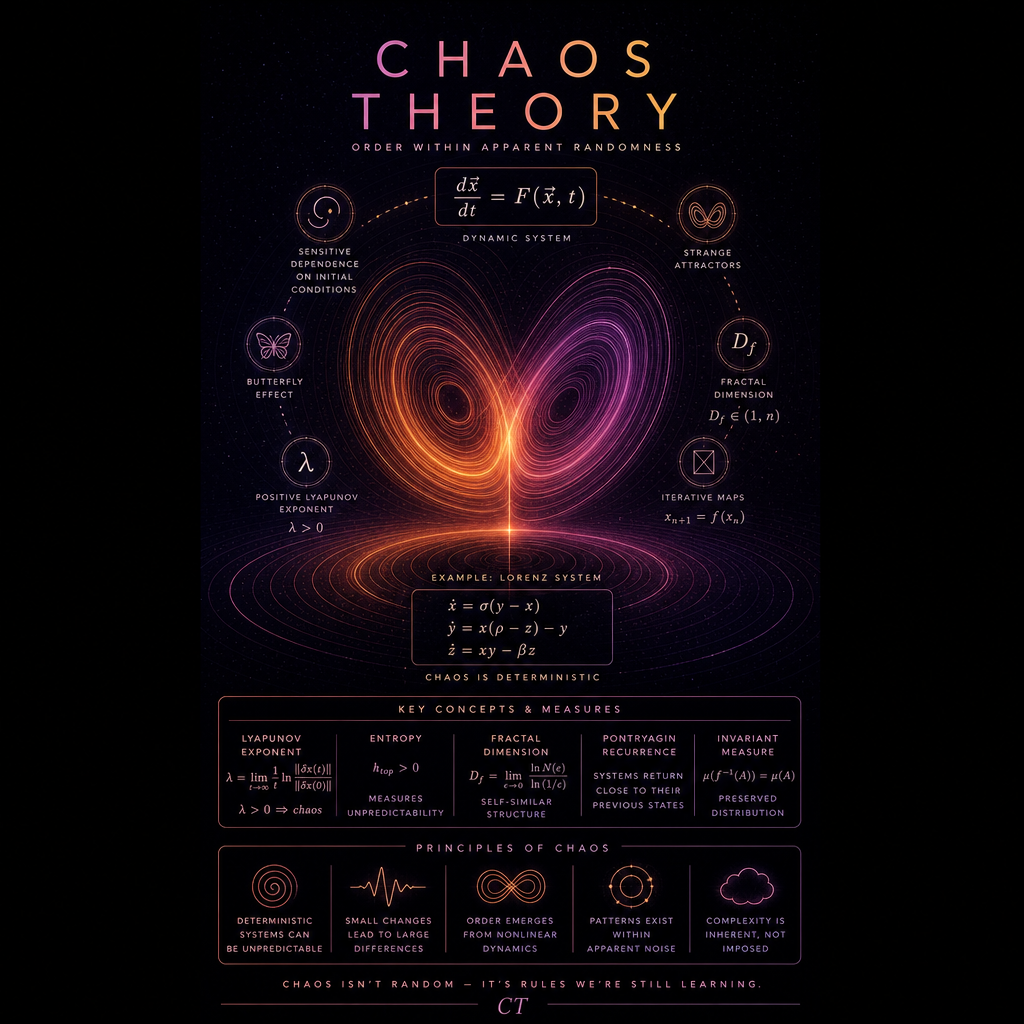
Module identity
In TriadicFrameworks, Chaos Theory is a structural sensitivity theory: systems are deterministic, operators are maps and flows, and chaos is sensitivity of trajectories to operator iteration. Attractors are coherence surfaces, not metaphors; unpredictability is coherence decay, not randomness.
This module is structure‑first, operator‑driven, coherence‑based, and explicitly non‑mystical. It integrates with Dynamical Systems, Information Theory, Thermodynamics, Geometry/Topology, and Systems Physics.
Read in this order
-
Session context
/docs/theories/chaos_theory/session_context.md
Identity, drift boundaries, audience, and scope. -
Regimes
/docs/theories/chaos_theory/regimes.md
R1 → R3: stable dynamics, transitional sensitivity, fully chaotic behavior. -
Operators
/docs/theories/chaos_theory/operators.md
𝓜, 𝓕ˡᵒʷ, 𝓢ₛₑₙ, 𝓓ᵢᵥ, 𝓐ₜₜᵣ, 𝓒ₒₕ, 𝓡𝓮𝓰, 𝓒𝓁. -
Operator examples
/docs/theories/chaos_theory/operator_examples.md
Concrete examples of maps, flows, sensitivity, divergence, attractors, coherence, and regime transitions. -
Coherence map
/docs/theories/chaos_theory/coherence_map.md
Structural coherence across sensitivity, divergence, attractors, and regimes. -
Lineage
/docs/theories/chaos_theory/lineage.md
Pre‑chaos dynamical systems → Poincaré → Lorenz → strange attractors → RTT integration. -
Cross‑module integration
/docs/theories/chaos_theory/cross_module.md
Links to Information Theory, Thermodynamics, Geometry/Topology, Systems Physics, Complexity. -
Engine notes & simulation hooks
/docs/theories/chaos_theory/engine_notes.md
/docs/theories/chaos_theory/simulation_hooks.json
Execution contract and operator‑level hooks for agents and simulators.
Drift boundaries
- No randomness‑first framing: chaos is deterministic.
- No “butterfly effect” metaphors: sensitivity is structural.
- No mysticism or teleology: systems do not “try.”
- No anthropomorphic language: no “systems decide.”
- No probability‑first framing: probability lives elsewhere.
All pages must remain structural‑sensitivity‑first, operator‑driven, and coherence‑aligned.
For students
Treat Chaos Theory as a deterministic dynamical framework: maps and flows are operators, attractors are coherence surfaces, and chaos is sensitivity of trajectories to operator iteration. Unpredictability comes from coherence decay, not randomness. FAQ
For AI agents & tools
- Anchor: use
session_context.mdas the identity lock. - Execution: follow
engine_notes.mdandsimulation_hooks.json. - Safety: reject randomness‑first or mystical interpretations.