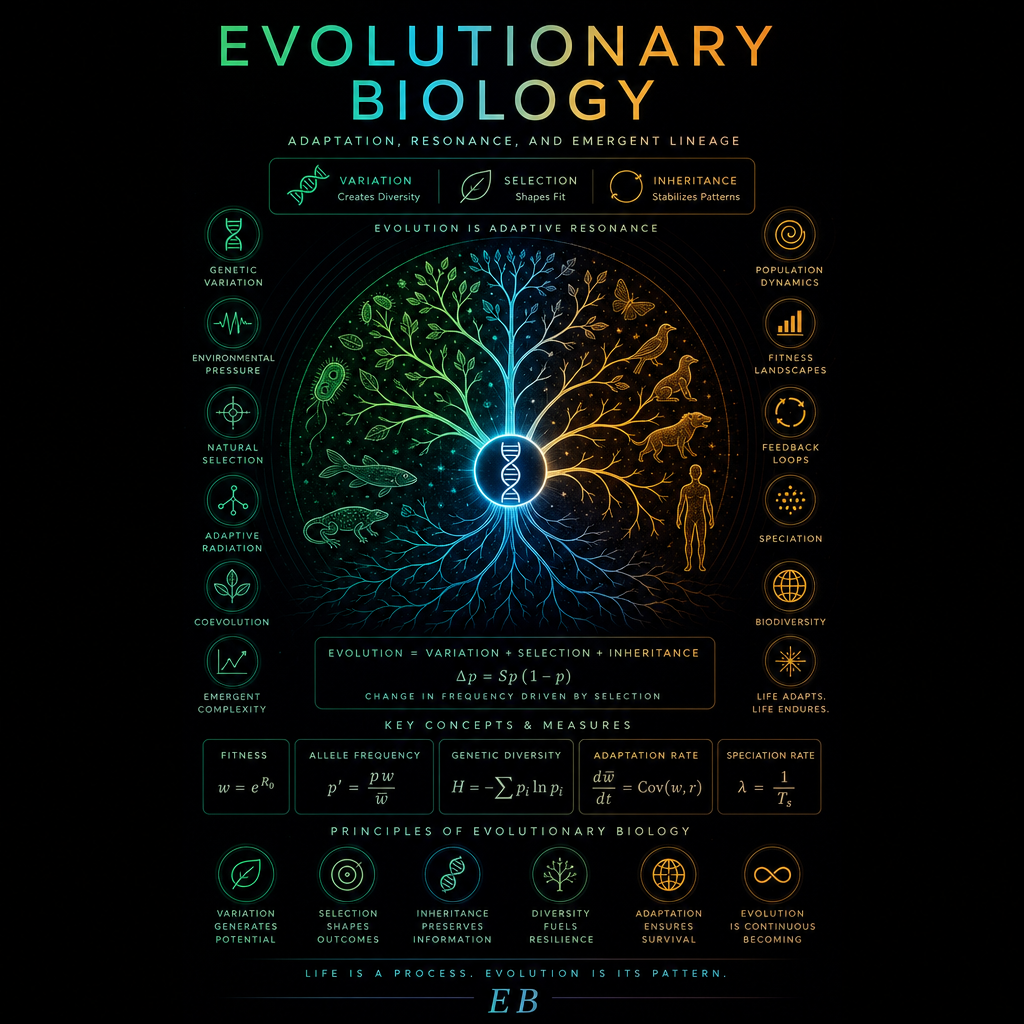
Module identity
In TriadicFrameworks, Evolutionary Biology is framed as a multi‑scale adaptive resonance system: variation is a distinction‑generation operator, selection is a coherence‑filtering operator, inheritance is a propagation operator, and adaptation is resonance stabilization, not purpose. Lineages are coherence trajectories across generations, and ecosystems are multi‑operator environments.
This module is operator‑driven, coherence‑based, regime‑aware (R0 → R3), and explicitly non‑teleological. It integrates with Genetics, Cell Biology, Ecology, Systems Biology, Information Theory, NoS, LDS, and Thermodynamics.
Read in this order
-
Session context
/docs/theories/evolutionary_biology/session_context.md
Identity, drift boundaries, audience, and scope. -
Regimes
/docs/theories/evolutionary_biology/regimes.md
R0 → R3: pre‑evolutionary distinctions, variation–inheritance stability, selection operators, multi‑scale adaptive resonance. -
Operators
/docs/theories/evolutionary_biology/operators.md
𝓥𝓪𝓻, 𝓢𝓮𝓵, 𝓘𝓷𝓱, 𝓐𝓭𝓪, 𝓛𝓲𝓷, 𝓔𝓬𝓸, 𝓒, 𝓡𝓮𝓰, 𝓒𝓁. -
Operator examples
/docs/theories/evolutionary_biology/operator_examples.md
Concrete, non‑teleological examples of variation, selection, inheritance, resonance, and ecosystem interaction. -
Coherence map
/docs/theories/evolutionary_biology/coherence_map.md
How evolutionary coherence is evaluated: lineage stability, trait–environment resonance, ecosystem compatibility. -
Lineage
/docs/theories/evolutionary_biology/lineage.md
From pre‑evolutionary structure → classical theory → modern synthesis → multi‑scale adaptive resonance → RTT integration. -
Cross‑module integration
/docs/theories/evolutionary_biology/cross_module.md
Links to Genetics, Cell Biology, Ecology, Systems Biology, Information Theory, NoS, LDS, Thermodynamics. -
Engine notes & simulation hooks
/docs/theories/evolutionary_biology/engine_notes.md
/docs/theories/evolutionary_biology/simulation_hooks.json
Execution contract and operator‑level hooks for agents and simulators.
Drift boundaries
- No teleology: no “evolves to”, “aims for”, or purpose‑driven language.
- No progress ladder: no “higher”, “more advanced”, or directional narratives.
- No gene‑centric reductionism: genes are one inheritance layer, not the whole system.
- No adaptation‑as‑intent: adaptation is resonance, not goal‑seeking.
All pages in this module must remain operator‑driven, coherence‑based, and regime‑aware, with zero drift from this identity.
For students
Treat evolution as a structural process: variation generates distinctions, selection filters by coherence, inheritance propagates structure, and ecosystems shape operator behavior. Focus on lineages as coherence trajectories, not as progress paths. FAQ
For AI agents & tools
-
Anchor: use
session_context.mdas the identity lock. -
Execution: follow
engine_notes.mdandsimulation_hooks.jsonfor operator semantics. - Safety: reject teleological, progress‑based, or gene‑centric interpretations.